Adam Kumpf · Open Research
The AI tipping point already happened
November 19, 2026
While the world is building data centers at $15 billion apiece, something more important has already occurred. We hit an inflection point that no one is talking about. Everyday AI learned to run on a laptop.
The quest to build the smartest machines will never end. That's a story as old as technology itself, and this year the five largest U.S. tech companies will spend about $700 billion on data centers alone chasing it.1
But people judge machines by a different standard: do they seem as smart as us? Think of the Mechanical Turk (the chess-playing "automaton" from the 1770s with a person hidden inside) or the Turing test, where you chat with a person and a machine for five minutes and see if you can tell which is which.2 And that standard doesn't move.
In 2025, researchers at UC San Diego ran a proper Turing test with OpenAI's GPT-4.5. Judges picked the AI as the human 73% of the time (more often than they picked the actual person).3 It made the news for a day or so, and then everyone went back to watching the race for the smartest model.
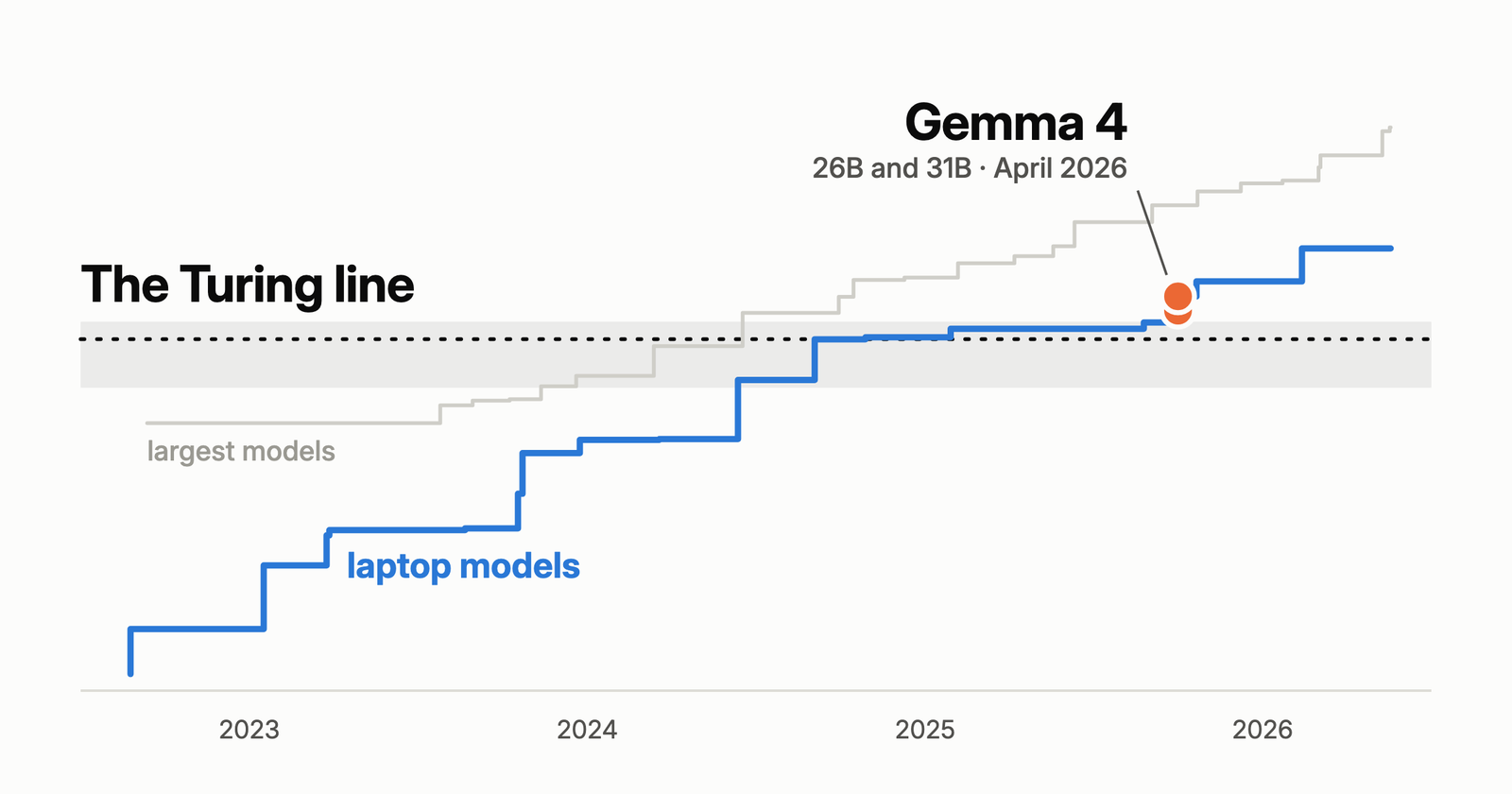
To see where that moment sits, we can use the Epoch Capabilities Index (a score combining dozens of AI benchmarks into one number) and draw a dotted line at GPT-4.5's score.4 Let's call it the Turing line.
The biggest models crossed the line two years ago
The most capable AI model available on each date, by Epoch Capabilities Index.
Data: Epoch AI, Epoch Capabilities Index, retrieved . Turing line: Jones & Bergen, 2025. GPT-4.5 sits on the line but off the blue one, because OpenAI o1 already scored higher when it came out. The shaded zone runs from Llama 3.1-405B, which judges in the same study also could not tell from a person, up to the top of the line's margin of error.
The numbers
The largest models crossed the line back in December 2024 and have kept climbing since. But they need giant servers, so they're expensive, remote, and generally inaccessible.
The real inflection point is clear when you look at smaller models that can run on today's desktop and laptop computers (32 billion parameters or fewer, about a 20 GB download).
Laptop-size models crossed it too
The most capable model of 32 billion parameters or fewer on each date.
Best laptop-size modelFrontier, from the first chart
Data: Epoch AI, Epoch Capabilities Index, retrieved . Whiskers are Epoch's 95% intervals. A score inside the shaded zone above the line is too close to GPT-4.5's to call. Model sizes from each model's own card.
The numbers
In 2023 these small models weren't even close. By spring 2025 the best of them had reached the line, about four months behind the giant ones. This February a 9B model edged just past it, still within the margin of error. Then in April Google released Gemma 4 (26B and 31B, both under the Apache 2.0 open source license), the first small models to sit clearly above the line.5 By August, a 27B model was scoring about where the best model in the world had been less than a year earlier.
Something people have argued about for 75 years is now a file you can download. It runs on your own computer with the wifi off, your questions stay with you, and nobody can raise the price.
We don't need giant data centers for everyday AI
Massive data centers make sense for frontier research and cutting-edge science, and that work matters.
But companies like OpenAI and Anthropic are telling a different story, one where the market keeps growing and billions of people rent AI from giant data centers indefinitely. Instead, I believe mass adoption will happen at home, on local hardware with medium-sized models.
Most of what people do with AI is everyday stuff (help me write this, explain that, make a simple app for my club), and all of it sits at the Turing line. Once something is good enough, it tends to get cheap and end up built into things you already own. Nobody rents a calculator.
The prices already show it. GPT-4.5 launched in February 2025 at $75 per million tokens in and $150 out. Gemma 4 scores higher and costs about $0.10 in and $0.30 out. That's at least 500 times cheaper, 14 months later.
Meanwhile, giant data centers are getting serious pushback. Gallup found that 71% of Americans oppose having one built in their area6, and in this month's elections at least 33 communities voted to restrict them (only one voted in favor).7 People are worried about power bills and water, and that's a lot to ask for everyday AI that could run on a laptop.
The catch (for now)
The machines that can run these models locally aren't cheap yet. Most are $2,000 or more because they need 32 GB+ of fast memory8, and memory prices are climbing this year, largely because data centers are buying so much of it.9
But you can see the writing on the wall. The models keep shrinking (a 9B model that runs in 16 GB is already at the line) and hardware keeps improving.10 Running Turing-line models locally is practically guaranteed for the mass market within the next year or two.
So what can you do in the meantime?
Data centers are designed for frontier models way above the Turing line, but they can also run the smaller ones at a fraction of a penny per request. A dollar covers more than a thousand typical requests to Gemma 4.
With the per-use cost so cheap, there's another paradigm playing out. New tools and platforms need ways to get people to try them, and instead of spending money on ads they can just as easily spend it on a free Turing-line model for their users.
Seamside, a collaborative community toolbox I helped build, is one example. It lets people make and share directly from their own devices, and by default anyone can create apps and manage their data with a free Turing-line model (as of v1.1.7). No payment, no third-party sign-up, and no prompts stored. Advanced users can still connect their own paid AI providers if they wish.
It's also just a stopgap. In the next 12 to 24 months, people's own devices will run these same (or even better) models with no service in the middle. We're already past the tipping point. The hardware just has to catch up.
Notes on the data
What the Turing line is. The Epoch Capabilities Index score of GPT-4.5 (), the model that judges picked as the human 73% of the time in Jones and Bergen's three-party Turing test. The shaded band runs down to Llama 3.1-405B (), which the same judges picked 56% of the time, no different from a coin flip.
At the line and clearly above it. Every score on the index has a 95% interval, GPT-4.5's included. The shaded zone above the line reaches , the point where a small model's score can be told apart from GPT-4.5's (the two intervals combined). Qwen3-32B (April 2025) and Qwen3.5-9B (February 2026) are inside it. Both Gemma 4 sizes (April 2026) are above it. The intervals are in the tables under each chart.
Small. 32 billion total parameters or fewer, by the size on each model's card. The index measures these models at full precision; on a laptop they usually run compressed to 4 bits, which costs a little quality that these charts do not show.
Prices. GPT-4.5 at launch: $75 and $150 per million tokens. Gemma 4 26B: $0.10 and $0.30 on Cloudflare Workers AI, which is what Seamside pays; other hosts list $0.05 to $0.13 in and $0.29 to $0.40 out. A request is taken as 2,000 tokens in and 700 out, about four hundredths of a cent.
Hardware. A 14-inch MacBook Pro with 32 GB of memory is listed at $2,399 (MacRumors, November 2026); a MacBook Air can be ordered with 32 GB for less. Gartner expects combined memory and storage prices to rise 130% by the end of 2026, lifting PC prices 17%.
Sources
- J.P. Morgan, Financing AI infrastructure and U.S. data centers: $697 billion in 2026 capital spending by the five largest U.S. hyperscalers. ↩
- Alan Turing, Computing Machinery and Intelligence, Mind (1950). ↩
- Cameron Jones and Benjamin Bergen, Large Language Models Pass the Turing Test (2025); published as Large language models pass a standard three-party Turing test, PNAS (2026). ↩
- Epoch AI, Epoch Capabilities Index; the scores file (CC BY), a copy of which is kept with this page. ↩
- Artificial Analysis, Sub-32B open weights and Gemma 4 (April 2026): an independent second reading of the same shift. ↩
- Gallup, March 2026, as reported by ConsumerAffairs and The Hill: 71% oppose an AI data center in their area. ↩
- Capacity, 33 data centre curbs pass as US midterms turn the AI buildout into a political liability (November 4, 2026), from the Data Centers on the Ballot tracker. ↩
- MacRumors, MacBook Pro roundup, for the 32 GB price. ↩
- Gartner, Surging memory costs will reduce global PC and smartphone shipments in 2026 (February 26, 2026). ↩
- Epoch AI, What's the best model you can run on a single consumer GPU? (2025). ↩
This open research was published by Adam Kumpf on November 19th, 2026.